Showing posts with label recommend. Show all posts

Wednesday, March 9, 2011

Netflix feature requests and parental controls

We get Netflix now.  The kids are loving Netflix streaming on the Wii.  We haven't watched as many big people movies as I had expected.  But, overall, it is a neat service.  And the value per entertainment dollar spent is fantastic.

But I'm a software guy.  And Netflix is a software service.  So, of course, I have ideas on how to improve it.

I've scoured Netflix's website and I cannot find any way to submit a feature request or give unstructured feedback.  This is a mistake, both for their business model and the software itself.  Companies today have to engage clients and digest the feedback.  They have a blog, and comments are allowed.  But there is no way to contact anyone directly or engage with the company.

I'll link this blog post in the comments of their latest blog posts.  I'm also going to post it on their wall on Facebook.  But I doubt it will get noticed.

With that all said, I've got two feature requests/suggestions for Netflix.

1. A General Feedback Mechanism
Duh!  There are thousands of users out there who have ideas they would like to share.  Just listening to their ideas makes your brand more engaging and sticky.  Some percentage of those ideas are good or great.  Those ideas will genuinely make your service better.

As a baby-step you can just implement one of the general-purpose feedback websites, like Suggestionbox.com.  (Suggestionbox created that site for them as a teaser to try to engage Netflix.  Netflix isn't actively using it yet.  I have no affiliation with Suggestionbox.)

But you already have a platform where you are engaging with people.  So I would suggest that you build a 'Netflix feature queue' right into your service.  Give people the ability to write up feature requests (like this one) and place them in the queue.  Let others read and prioritize those features.  I'm sure that you have an agile development team (or three).  Put their scrum backlog in there and let clients interact with it.

You will have to moderate the content, obviously.  You will have tons of 'I got a DVD of Teen Wolf 2 that was scratched.'  Some of your customer service people will have to review every incoming post and filter out the stuff that doesn't fit.  And they will have to merge similar requests.

But when you build a feature that was customer-designed you should scream it from the rooftops.  Send someone out to get a picture of the person who wrote up the idea.  Give them a free month of service and a shirt.


2. Granular Parental Controls
I haven't seen anything from Netflix that suggests they want people to sign up for more than one account per household.  That means parents and children are sharing queues and streaming devices.  We have 4 kids--a large-ish family by modern American standards.  But I would suggest that our usage patterns are probably fairly typical.

In our house this means that the 'Suggested for Randy' queue is:
* Clifford
* Angelina Ballerina
* Se7en
* Salt
* Ben-10
* The Shawshank Redemption
* Blues Clues
* Dexter
* Cake Boss
* Shaun the Sheep
* The Blues Brothers
* Enter the Dragon
* Zombieland

This is disconcerting for me as a parent, because so many of my shows appear at the top of the queue when my kids are picking shows.  I don't need my kids watching even a few minutes of Se7en or Dexter while they know that I'm busy doing something else.

We have a Wii with Netflix streaming on our main TV.  We have Netflix streaming on the adult's computers, but we don't want to watch movies at our desks.  Everyone basically shares the main TV for Netflix.

We have 2 preschoolers (who can navigate the Netflix menu on the Wii and pick their shows.)  We have a 9 year old, a 13 year old, and two adults.  In a perfect world that's 5 separate instant queues on this device.  In reality, though, if each of the big kids got a personal queue then both of the little ones would demand their own queues, too.  So that's 6 separate instant queues on the Wii.

Each queue needs an optional password.

When I'm in a queue, I need to see the name of the queue at the top of the screen.  (On the Wii, the queues should each have a Mii.)

If I have several streaming devices (Wii, iPad, computer, streaming Blue-Ray player, etc.), then I should be able to pick which queues appear on which devices  The default should be for all queues to appear as options on all devices.  Some devices won't be able to handle multiple queues, especially at first, so they will have to default to just the first queue.

Each queue needs to have it's own settings for what's allowed.

There is a sticky problem on content that is not rated--old movies and TV shows.  So I would base the parental controls on a combination of Common Sense ratings and MPAA ratings.  And for the shows that are not rated by either service, I would control by genre.

So my parental control options would look like this:

Little Jenny's queue allows:
* All shows
* R and below
* PG-13 and below
* PG and below
* G and below
For shows that are not rated by the MPAA, allow:
* All shows
* Common Sense age 17 and below
* Common Sense age 14 and below
* Common Sense age 11 and below
* Common Sense age 8 and below
* Common Sense age 4 and below
* No shows not rated by the MPAA 
For shows that are not rated by the MPAA or Common Sense, allow:
# Action & Adventure
# Anime & Animation
# Children & Family
# Classics
# Comedy
# Documentary
# Drama
# Faith & Spirituality
# Foreign
# Gay & Lesbian
# Horror
# Independent
# Music & Musicals
# Romance
# Sci-Fi & Fantasy
# Special Interest
# Sports & Fitness
# Television
# Thrillers

For that last category the interface is checkboxes, not a single select.  A movie that is categorized as both 'Documentary' and 'Gay & Lesbian' would be blocked unless both categories are checked here.

Few parents are going to select 'Gay & Lesbian' or 'Horror', but the control settings should simply include all genres for simplicity's sake.  Any new genre that gets added to the system should show up here, and be unchecked for everyone who has already set up their parental controls.

Thursday, February 3, 2011

Monday, October 4, 2010

The Predictioneer's Game

I just finished reading 'The Predictioneer's Game' by Bruce Bueno de Mesquita.  If you are interested in the future this is a must read.

Bruce is one part economist, one part social scientist, and one part mathematician.  He has developed a formula that describes the negotiation process.  He studies each party to a negotiation and assigns numerical values (0 to 100) to their positions, goals, and power.  Then he solves the formula and predicts the results of the negotiation.

His work is based upon game theory.  So he calls each negotiation a 'game'.  He gives examples of wars, negotiations leading up to wars, bidding wars, lawsuits, elections (and sham elections), multi-party political struggles, and car buying.  His explanation of how to get the best price for a new car is the most buyer-empowering process I have ever seen.  (Unfortunately it only applies to new cars.)

I find this approach very appealing.  He doesn't give away any of the formula itself.  He only explains the variables that he assigns as inputs.  Frankly, that's enough for me.  I don't want to do the math.  That's why we have computers.

He cites several examples of correct predictions.  The future predictions that he gives appear to be reasonable, and not obvious to anyone who does not approach the subject through this type of disciplined methodology.

He has posted an online version of his game.  So you can prepare a tab-delimited text file with a series of values representing each party of the negotiation, and then upload the file and see the results of the game.  He doesn't show you the formula.

Of course this is only a methodology, and not a guarantee.  He gives several examples when his predictions failed.  And it appears that he has a pretty good grasp of the failure conditions.  The biggest two failure conditions are outside interruptions (natural disasters, sex scandals, and other exceptional events that interfere with the negotiation process) and people who do not seek their own advantage (idiots and idealists.)  But these two issues are problems for game theory in general, and not unique to his methods.

There are a few modifications that I would like to see implemented in Bruce's formula and process .  The following won't make much sense if you haven't read the book.

Three Goals
His process only accounts for a single goal for each party.  I don't think that humans usually work that way.  I think that we usually have three different goals in mind:
* Ideal - The perfect state that we hope to achieve.
* Expected - The result that we expect to be able to achieve.
* Minimum - The poorest result that we are willing to accept.

The intervals between these goals affect the way that we play the game.  It's probably a fallacy to identify a 'normal' game.  But the most obvious case for these three goals would be that a person's Ideal goal is higher than their Expected goal, and both of those are higher than their Minimum goal.  In this situation a person is likely to negotiate and act in good faith.

If a person's Expected goal is very close to either their Ideal or Minimum goal, above their Ideal goal, or below their Minimum, then it will greatly alter their approach to the negotiation.

When a person's Expected goal is very close to their Ideal goal then they will shift into either a more flexible or a more rigid negotiating strategy.  Pragmatists will become more flexible in order to get the process over with quickly.  True believers, idealists, and other extremists will become more rigid as they get caught up in the fervor of reaching their Ideal goal.  (This might be the true test of an idealist.)

When a person's Expected goal is very close to their Minimum goal they will use a very rigid negotiating strategy and expend a great deal of time and energy on the negotiations.

When a person's Expected goal is lower than their Minimum goal they are going to either undermine the process, cheat, and otherwise act in poor faith, or they will expend a tremendous amount of time and energy in an incredibly flexible negotiating strategy.  For example, a dictator will not join a negotiation where they expect to be hanged as a result.  But a murderer who has been arrested will negotiate nearly anything to get out of the death penalty.

When a person's Expected goal is higher than their Ideal goal they are going to treat this negotiation as a means to an end to improve their negotiating position in some other game.  This is the ugly political process of giving votes on one issue to gain votes on a separate issue.

Context
Every negotiation takes place within a context.  Each participant has other concerns that they are concurrently negotiating (or expect to begin negotiating soon.)  The participants have an existing relationship, and expectations for a future relationship.  And there are other parties who are not directly involved in a particular negotiation, but who have an interest in either a resolution to negotiations or to one or more of the participants.

Each participant has many ongoing negotiations.  If this negotiation is not one of their top priorities then it will not get their full attention.  They will probably delay it where possible.  When delay becomes impossible they will adopt a very flexible negotiating strategy in order to get done quickly.

The more negotiations that a person has going on, or expects to have going on soon, the more likely they are to be willing and able to be very flexible in their negotiation strategy.  This is especially true when some of the other participants to this negotiation are also participants in other negotiations.  This is the type of situation where politicians trade votes.

When two or more parties negotiate multiple separate games, over time, they establish a relationship.  Each participant will form an opinion of the other participants, especially concerning their trustworthiness.  Participants who have a long history of negotiating successful games will be able to negotiate more flexibly with each other because of the trusting relationship.  And conversely, when trust has been betrayed in the past  then current and future negotiations will be less flexible.

When one or more participant wants to negotiate more games after the current one, then that person will adopt a more flexible negotiating strategy.  For instance, a businessperson who is attempting to establish a reputation and earn repeat business will negotiate more deeply than an established company.

Sometimes there are external parties who may choose to interfere with a particular negotiation game.  There is a near-unlimited number of possibilities here.  Friends, enemies, and parties to other negotiations (current or future) are the prime suspects here.  A mistress, for instance, may be content to remain hidden until the money and notoriety from exposure gets too great.  Or someone may see an opportunity to hurt an old enemy by interfering with a negotiation.

I'm not certain that all of these scenarios are worth codifying within the prediction formula.  But I believe that for important negotiations each of these possibilities should be examined as a possible tactic for improving one's position.  That type of strategic and tactical research is what Bruce's consulting company does.

Stupidity
Humans aren't always rational.  Sometimes people just fail to see an opportunity.  Sometimes people have hidden constraints that limit them from exercising an obvious negotiation tactic.  Sometimes people bluff.  And sometimes your estimations of their goals and values are simply incorrect.

This is something that the predictive formula should be able to test and adapt for.  Almost all negotiations take place over a series of rounds.  As each round concludes you can compare the predicted and actual positions.

It is not as simple as updating the formula with the actual values and recomputing.  Each variation needs to be examined and explained.  Those explanations need to be fed into the strategic and tactical plans for future rounds of negotiation.

If you decide that someone is bluffing then you need to decide if you want to extract more concessions from them, at the risk of moving their Expected goal above their Minimum goal and causing them to begin subverting the negotiations.

If you decide that someone has a hidden constraint and cannot ask for a concession that they need, then you can use that information to your advantage.  Maybe you can threaten to expose their weakness to coerce greater concessions.  Or maybe you can offer the concession as an olive branch, in order to gain the upper hand.

If you decide that someone is simply stupid then you can play them in order to gain greater concessions.  You can arrange the situation to make the stupid person look heroic while they make much larger concessions than they should.  Call this the Neville Chamberlain tactic.

The Predictioneer's Game

I just finished reading 'The Predictioneer's Game' by Bruce Bueno de Mesquita.  If you are interested in the future this is a must read.

Bruce is one part economist, one part social scientist, and one part mathematician.  He has developed a formula that describes the negotiation process.  He studies each party to a negotiation and assigns numerical values (0 to 100) to their positions, goals, and power.  Then he solves the formula and predicts the results of the negotiation.

His work is based upon game theory.  So he calls each negotiation a 'game'.  He gives examples of wars, negotiations leading up to wars, bidding wars, lawsuits, elections (and sham elections), multi-party political struggles, and car buying.  His explanation of how to get the best price for a new car is the most buyer-empowering process I have ever seen.  (Unfortunately it only applies to new cars.)

I find this approach very appealing.  He doesn't give away any of the formula itself.  He only explains the variables that he assigns as inputs.  Frankly, that's enough for me.  I don't want to do the math.  That's why we have computers.

He cites several examples of correct predictions.  The future predictions that he gives appear to be reasonable, and not obvious to anyone who does not approach the subject through this type of disciplined methodology.

He has posted an online version of his game.  So you can prepare a tab-delimited text file with a series of values representing each party of the negotiation, and then upload the file and see the results of the game.  He doesn't show you the formula.

Of course this is only a methodology, and not a guarantee.  He gives several examples when his predictions failed.  And it appears that he has a pretty good grasp of the failure conditions.  The biggest two failure conditions are outside interruptions (natural disasters, sex scandals, and other exceptional events that interfere with the negotiation process) and people who do not seek their own advantage (idiots and idealists.)  But these two issues are problems for game theory in general, and not unique to his methods.

There are a few modifications that I would like to see implemented in Bruce's formula and process .  The following won't make much sense if you haven't read the book.

Three Goals
His process only accounts for a single goal for each party.  I don't think that humans usually work that way.  I think that we usually have three different goals in mind:
* Ideal - The perfect state that we hope to achieve.
* Expected - The result that we expect to be able to achieve.
* Minimum - The poorest result that we are willing to accept.

The intervals between these goals affect the way that we play the game.  It's probably a fallacy to identify a 'normal' game.  But the most obvious case for these three goals would be that a person's Ideal goal is higher than their Expected goal, and both of those are higher than their Minimum goal.  In this situation a person is likely to negotiate and act in good faith.

If a person's Expected goal is very close to either their Ideal or Minimum goal, above their Ideal goal, or below their Minimum, then it will greatly alter their approach to the negotiation.

When a person's Expected goal is very close to their Ideal goal then they will shift into either a more flexible or a more rigid negotiating strategy.  Pragmatists will become more flexible in order to get the process over with quickly.  True believers, idealists, and other extremists will become more rigid as they get caught up in the fervor of reaching their Ideal goal.  (This might be the true test of an idealist.)

When a person's Expected goal is very close to their Minimum goal they will use a very rigid negotiating strategy and expend a great deal of time and energy on the negotiations.

When a person's Expected goal is lower than their Minimum goal they are going to either undermine the process, cheat, and otherwise act in poor faith, or they will expend a tremendous amount of time and energy in an incredibly flexible negotiating strategy.  For example, a dictator will not join a negotiation where they expect to be hanged as a result.  But a murderer who has been arrested will negotiate nearly anything to get out of the death penalty.

When a person's Expected goal is higher than their Ideal goal they are going to treat this negotiation as a means to an end to improve their negotiating position in some other game.  This is the ugly political process of giving votes on one issue to gain votes on a separate issue.

Context
Every negotiation takes place within a context.  Each participant has other concerns that they are concurrently negotiating (or expect to begin negotiating soon.)  The participants have an existing relationship, and expectations for a future relationship.  And there are other parties who are not directly involved in a particular negotiation, but who have an interest in either a resolution to negotiations or to one or more of the participants.

Each participant has many ongoing negotiations.  If this negotiation is not one of their top priorities then it will not get their full attention.  They will probably delay it where possible.  When delay becomes impossible they will adopt a very flexible negotiating strategy in order to get done quickly.

The more negotiations that a person has going on, or expects to have going on soon, the more likely they are to be willing and able to be very flexible in their negotiation strategy.  This is especially true when some of the other participants to this negotiation are also participants in other negotiations.  This is the type of situation where politicians trade votes.

When two or more parties negotiate multiple separate games, over time, they establish a relationship.  Each participant will form an opinion of the other participants, especially concerning their trustworthiness.  Participants who have a long history of negotiating successful games will be able to negotiate more flexibly with each other because of the trusting relationship.  And conversely, when trust has been betrayed in the past  then current and future negotiations will be less flexible.

When one or more participant wants to negotiate more games after the current one, then that person will adopt a more flexible negotiating strategy.  For instance, a businessperson who is attempting to establish a reputation and earn repeat business will negotiate more deeply than an established company.

Sometimes there are external parties who may choose to interfere with a particular negotiation game.  There is a near-unlimited number of possibilities here.  Friends, enemies, and parties to other negotiations (current or future) are the prime suspects here.  A mistress, for instance, may be content to remain hidden until the money and notoriety from exposure gets too great.  Or someone may see an opportunity to hurt an old enemy by interfering with a negotiation.

I'm not certain that all of these scenarios are worth codifying within the prediction formula.  But I believe that for important negotiations each of these possibilities should be examined as a possible tactic for improving one's position.  That type of strategic and tactical research is what Bruce's consulting company does.

Stupidity
Humans aren't always rational.  Sometimes people just fail to see an opportunity.  Sometimes people have hidden constraints that limit them from exercising an obvious negotiation tactic.  Sometimes people bluff.  And sometimes your estimations of their goals and values are simply incorrect.

This is something that the predictive formula should be able to test and adapt for.  Almost all negotiations take place over a series of rounds.  As each round concludes you can compare the predicted and actual positions.

It is not as simple as updating the formula with the actual values and recomputing.  Each variation needs to be examined and explained.  Those explanations need to be fed into the strategic and tactical plans for future rounds of negotiation.

If you decide that someone is bluffing then you need to decide if you want to extract more concessions from them, at the risk of moving their Expected goal above their Minimum goal and causing them to begin subverting the negotiations.

If you decide that someone has a hidden constraint and cannot ask for a concession that they need, then you can use that information to your advantage.  Maybe you can threaten to expose their weakness to coerce greater concessions.  Or maybe you can offer the concession as an olive branch, in order to gain the upper hand.

If you decide that someone is simply stupid then you can play them in order to gain greater concessions.  You can arrange the situation to make the stupid person look heroic while they make much larger concessions than they should.  Call this the Neville Chamberlain tactic.

Saturday, August 28, 2010

Tuesday, August 24, 2010

Western Digital rocks!

My desktop PC has a pair of Western Digital 74GB Raptor drives in a RAID array.  For you non-techies, these are the fastest hard drives generally available, arranged in the fastest possible configuration.

One of the drives died in 2008.  Western Digital replaced it for free.  Their return process is super-slick.  They shipped me a replacement drive, 2nd day, at no cost.  I just paid to ship the dead drive back to them via the cheapest trackable method.

Early last week the other original 74GB drive started to generate errors.  This time the errors were just bad sectors, and my RAID controller just started keeping count of the bad sectors and not using them.  But it alerted me.  I contacted Western Digital and my original warranty still has just over a year on it.  They shipped me a replacement drive for free.

But.....

The new drive I received today was a 150GB drive.  I tried installing it and my RAID controller doesn't like it.  I think that there is probably a hack-around that would get the controller to format the 150GB drive as a 74GB drive, but it didn't want to do it.

So I called Western Digital technical support back and told them my problem.  They said that they sent me a 150GB drive because they don't have any more 74GB drives.  They were discontinued years ago and they just don't have any more.

I didn't make any threats.  I asked very nicely if there was any way or program for me to swap out my old 74GB drive for another 150GB so I could run in a RAID array again.  And they agreed to send me another free upgrade replacement.  Whoo hoo!

So my desktop computer is down until the second hard drive arrives.  But I can live on my laptop for a week.  The drive should arrive Thursday or Friday.  I'll ship both old drives back on Monday, or so.

But with just a little bit of hassle I'm getting to double my hard drive space for very little cost.  Yeah!

Monday, August 16, 2010

TaeKwnDo recommendation

Bryan Evans runs Leander TaeKwanDo.  He's a good guy.  He's great with kids.  If you're in the Leander area, you should give it a try.

Tuesday, July 27, 2010

Inception

Fantastic movie.  Go see it.  It's worth seeing on the big screen, so don't wait for the DVD.

I love this movie.  In the spoiler section I will disect it at great length, and it may seem that I dislike the movie.  Nothing could be farther from the truth.  Wonderful.  But with a few nagging imperfections.

As an aspiring writer, I came away awed and encouraged.  This is the best writing I've seen come out of Hollywood, since The Dark Knight (also by Christopher Nolan.)  I missed many of his earlier works.  I'm going to have to watch those movies, now.

There are many discussions on the web about this movie already.  Max found this article, which is a good place to start (full of spoilers) (thanks for the link, Max.)

This movie is PG-13.  It is beautiful to watch.  It is technically safe for younger kids, if those kids have seen movie violence before.  Explosions, but little blood.  Few curse words.  No sex.  But it requires a depth of attention that younger kids won't be able to muster.  And there is at least one emotionally intense scene that would make kids younger than 13 very uncomorftable.  So don't take younger kids until you have seen it and decide if they can handle it.  I'm not letting Jet see it for several years.

This little comic is a neat intro to the movie.  No spoilers.  It will help you not feel completely lost for the first 20 minutes.  Maybe that is cheating, though.

I have many thoughts about the movie itself and the universe where this sort of thing is possible.  I'm hiding them below the 'more' link, because there are a ton of spoilers here.  Don't read below here if you have not seen the movie.

Monday, April 12, 2010

What is it for, then?

Food isn’t about Nutrition
Clothes aren’t about Comfort
Bedrooms aren’t about Sleep
Marriage isn’t about Romance
Talk isn’t about Info
Laughter isn’t about Jokes
Charity isn’t about Helping
Church isn’t about God
Art isn’t about Insight
Medicine isn’t about Health
Consulting isn’t about Advice
School isn’t about Learning
Research isn’t about Progress
Politics isn’t about Policy


Marginal Revolution points to an intriguing post at Overcoming Bias, which in turn points to an earlier O.B. post, which in turn points to yet another earlier similar interesting post.

The source articles on O.B. are pretty thick.  Robin Hanson is an academic's academic.  Nice guy, but he doesn't write for normal folks to read.  I'll recap for you:
* Scientists can't figure out why human brains are so large.  One (apparently new) theory is that humans are unconsciously deceptive--we tell ourselves and each other a near constant stream of lies, and we have to have these too big brains in order to encode and decode all of the lies.
* We can think of this dishonesty as sending signals to fool our competitors, like bluffing (a simple example; there are hundreds of other examples.)
* Society is then made up of people who are all being dishonest all the time in little ways.  The net result is that no individual gets what they want.  But as a whole society generally performs fairly well; because the average of all of those little lies is very close to the average of all of the little truths behind the lies.
* If we examine human institutions from the assumption that everyone is signaling and hiding their real desires and/or intentions, then previously confusing situations become clear (or, at least, clearer.)
* The system is vulnerable to truth-tellers.  In large and small situations, truth-tellers can unmask the deceptions and get what they want, over the short-term.  Over the long-term people will return to their comfortable little lies; because their large brains are hard-wired for it.
* Truth-tellers have to be careful.  These messengers tend to get shot.

I love the 'X isn't about Y' poem (rhyming concepts instead of sounds.)  This is how Robin explains it: "When I say “X is not about Y,” I mean that while Y is the function commonly said to drive most X behavior, in fact some other function Z drives X behavior more."

Identifying and naming the various Z's can be fun and enlightening.  Probably different people have different Z's.  For instance, for one person clothes might really be a signal of their status and/or group membership (business people in suits, or gang members, for instance) and for others clothing might be about hiding their true identity.  Maybe not, though.  That was the best example I could think of, and its a pretty slim distinction.

Then maybe this is a Rorschach test.  How would you fill in these blanks?

Clothes are really about ___________________.
Bedrooms are really about ___________________.
Marriage is really about ___________________.
Talk is really about ___________________.
Laughter is really about ___________________.
Charity is really about ___________________.
Church is really about ___________________.
Art is really about ___________________.
Medicine is really about ___________________.
Consulting is really about ___________________.
School is really about ___________________.
Research is really about ___________________.
Politics is really about ___________________.

That third linked article from O.B. is about what Robin thinks Politics is really about.  Robin thinks that politics are about getting respect.  If that is true then a Manchurian Candidate could focus on a message of respect and win in a landslide.  So this is not necessarily just an academic exercise.  If we know what someone really wants then we can find new and innovative ways to meet that need.

My own answers are pretty cynical.  That probably has something to do with my mood today.  I might revisit this post when I'm feeling happier.

Clothes are really about group membership.
Bedrooms are really about feelings of insecurity.
Marriage is really about loneliness.
Talk is really about emotional connection.
Laughter is really about embarrassment and confusion.
Charity is really about affirming myself.
Church is really about seeking affirmation.
Art is really about communicating unpopular opinions.
Medicine is really about fear.
Consulting is really about covering myself.
School is really about conformity.
Research is really about competition.
Politics is really about stealing money from the public.

Some of these I have thought and felt for a long time.

I have a note taped to my desk that says "The goal of communication is emotional connection.  Fact transmission is only a useful by-product."  I've had it for years.  I can't remember where I got the idea, but I have understood for years that I am too focused on facts and too ignorant of emotional connection.  It's a weakness that I am working on.  Obviously there is much left to do.

I read Steve Martin's biography, Born Standing Up.  Steve goes into great detail about his early experiments in comedy.  He began experimenting with telling jokes that lacked punchlines.  He would just riff from discomfort to confusion and garner laughter from the audience's inability to decide what else to do.  (Of course he explains it much better than that.)

Democracy 2.0 is a flaming critique of the political establishment.  My feelings about politics are well documented.

But I have been struggling with how to communicate Democracy 2.0 for years, too.  I've thought a lot about art as a medium for communicating Democracy 2.0, or as least my critiques of the current system.  I've been thinking about writing fiction as a way to communicate my critiques.

I used to manage a team of consultants.  It's not a secret within the consulting community that people hire consultants as a form of job insurance in case the project fails.  The consultants always take the blame.  Any consultant who attempts to subvert this unwritten rule will find himself/herself off contract and blackballed.

The critique of charity is an old saw.  This was Freud's explanation for charity, if I remember correctly.

My opinion of church will be quite controversial among my friends, and so I feel like a word of explanation is necessary.  There are two types of people in church: believers and non-believers.  Fellowship among believers is essentially a form of affirmative encouragement.  Non-believers seem to be looking for someone to tell them that they are ok.  The word 'encouragement' covers the believers, but not the non-believers.  'Affirmation' covers both groups better.  If you have a better word then I'm all ears.

Monday, April 5, 2010

Amy Winehouse - Back to Black

I picked up this disc at Half Price Books a few weeks ago.  I had heard good things about it from someone who had gotten me started listening to jazz.

Wow.

I had heard Rehab on the radio.  I had seen the tabloid exploitation of her personal life.  But I wasn't ready for the album.

The Billboard bio is a good starting point for understanding who this person is.  I laughed at these two quotes from their bio:
* "The British press and tabloids seemed to focus on her rowdy behavior and heavy consumption of alcohol, but fans and critics alike embraced her rugged charm, brash sense of humor, and distinctively soulful and jazzy vocals."
* "Nonetheless, her allure has been her songwriting -- almost always deeply personal, but best known for its profanity and brutal candor."

In her songs she is a very bad girl.  "I'll be some next man's other woman soon."  That's not the half of it.  You could call her every name in the book, and she would laugh and agree.  It seems to be all too true.  What an amazing human train-wreck.

I can't think of another example of a bad person who so thoroughly owns their actions.  It's fascinating.  Regret and self-contempt drip from every song.  But she shrugs and admits that she can't change.  If only we could all be so honest.

The lyrics stand on that honesty and openness.  But that's not all there is to this album.  The lyrical poetry is pointed and crisp.  The vocals are as soulful as you've heard.  Her voice is musky and dark, but not what I would call beautiful or powerful.  Her voice matches the lyrics and the music.

The musicians get little credit.  The liner notes say that Amy wrote most of the songs.  There are many musicians, and different musicians on many songs.  But the musicians play to her.  They set the ball right in front of her at the net, and let her take the credit for spiking it.  They play their parts well.  If you didn't speak English you could still enjoy the arrangements and the sounds of it all.

I watched a few videos of Amy's live performances on YouTube.  They lack the power of the album.  Maybe she's just too drunk to perform.  Maybe the studio professionals really are working a miracle on the album.  But as much as I enjoy the album, I wouldn't bother seeing her in concert.

I heartily recommend the album.  There are many bad words, and even the clean words are talking about adult situations (like adultery.)  But you have never heard an adulteress speak so candidly about her failures.  So this is definitely not an album for kids.

But it is a beautiful catastrophe to behold.

Sunday, December 20, 2009

Go see Annie!

Christy and I just saw Annie at the Palace Theater in Georgetown.  The Brawners stole the show.  It was great fun, very energetic.  James played 3 or 4 roles, and danced once or twice as an extra.  He was really busy, and he did a great job.  His radio announcer was very funny and perfectly timed.  His butler was attentive and defferential.  And he danced very well.

There were some community theater moments, but they were few and far between.  There were tons of kids in the cast, and they all did great.  Annie was particularly good.

They have more shows through the end of the year.  You should check it out.

Tuesday, December 15, 2009

A good car diagnostics guy

My Mustang has been acting up for several months.  I thought I had it fixed, but it continued to mess up.  I asked around among my friends for a name of a mechanic who is good at troubleshooting and figuring out complicated or difficult problems.  Mike Burns gave me the name of a mechanic who had been recommended to him.

Greg Potts.  His shop is called Red Lion Motors.  (512) 267-7330.  His shop is off in the woods, down a gravel road.  Take 1431 west from 183.  It's the second u-turn after the new New Hope stoplight, about the time you think you are leaving Cedar Park.

He's a former IBM guy with a degree in Electrical Engineering from Drexel.  Nice guy.  Ask to see his Corvette project car while you are there.

He figured out that I had trash of some sort in my power steering fluid that was jamming up my power steering pump at random times.  That's why my power steering pump would lock up and kill the engine if I was at idle.  I thought it was the power steering pump--I replaced it 3 times in 6 months.  Greg also figured out that Ford recently suggested flushing all of the power steering fluid and switching to a certain automatic transmission fluid in my model of Mustang.  Ford won't say why, but I'm betting it is related.

It took longer than I hoped, and cost a little more.  But it worked.  And I didn't have to spend any more money or time changing things and hoping to fix it.

If you have a tough problem that needs a really good diagnostic guy, call Greg.

Wednesday, December 9, 2009

Funny TED talk on design

I don't know this guy beyond the bio on this page. But I really enjoyed his TED talk.

His last two questions/points really jumped out at me.  I don't want to spoil the video for you, so I'll hide my thoughts below the 'more' link.

Wednesday, December 2, 2009

New tool: Notepad++

I've been using UltraEdit for about 6 years, and I love it. I bought a 10-user license at Journyx and several people there used it.  Massive files.   Search and replace through multiple files or a whole directory.  Compare multiple files.  Macros.  HTML markup.  And it works great at stripping out non-printable characters that often caused problems for Timesheet.

When I left Journyx I had to format my drives and reinstall OSes and other software that I owned licenses for--my laptop was owned by Journyx and I was using some Journyx-owned software on my home desktop PC, too.  Now I am free of Journyx-owned licenses (buying Windows 7 and Office was painful.)  I still have a copy of Journyx's Ultra-Edit license, but I decided not to use it.

Ultra-Edit is $50.  I just can't swing that right now.  I've been using Notepad for all of my blog posts and HTML editing for thehiringsurvey.com.  That has gotten very old very fast.

Today I searched around for Ultra-Edit competitors, hoping to find something cheaper.  I found Notepad++. It doesn't have all of the bells and whistles of UltraEdit.  But it seems to work very well.  The HTML markup is very pretty and easy to read.  And it's free.  It seems to be clean of scumware and adware--big problems for free software.

Whoo-hoo!  Yeah Internet!

Friday, October 23, 2009

If you've seen it you'll have to agree

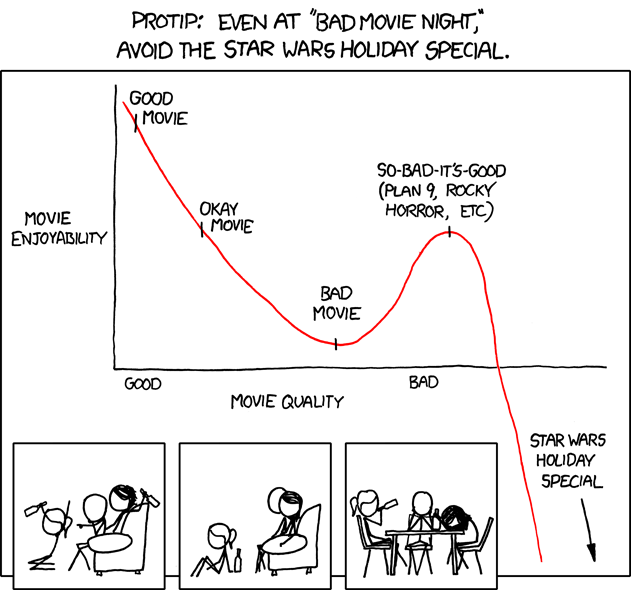
If you don't read XKCD than you should.  Consistently funny.  Sometimes I laugh so hard I hurt myself.  This morning I had a raisin go up my nose because I was laughing so hard:


Oh, and when you read the comic on the XKCD site make sure to mouse-over for a second punch line. Funny stuff.

Saturday, October 17, 2009

Brilliant new computer interface design

Watch the video:
http://10gui.com/video/

I don't know if this will really work, but the brainstorming and work that went into it are clearly high quality.  I'm not sure I would bet against this.

The one thing I would add is to build the keyboard into the touch sensor.  You would need some sort of toggle to switch from navigation pad to keyboard.  And the pad would require some sort of minimal illumination that could show you the outline of the keys, for those of us who still look down at the keyboard sometimes.

Friday, October 9, 2009

Wild at Heart

I just finished reading 'Wild at Heart' by John Eldredge.  Great book.  I highly recommend it.  Especially if you are considering making some changes in your life.  Parents of boys need to read it, too.  And young men should read it at around 16 or 17, I think.

As is my custom, what follows are a few notes to myself about what I got out of the book.  This is just a tease for you who haven't read it.  If the quotes and points below intrigue you, go read the book and then ask me questions.  :-)

If you read below, you will see that I have my answers with regards to Plan A / Plan B....

Wednesday, October 7, 2009

48 Days to the Work You Love

Last night I read '48 Days to the Work You Love' by Dan Miller.  Great book.  Easy to read.  Poignant.  Powerful.  Full of ideas.  This one is worth reading whether you are job searching right now or not.  The notes below barely qualify as a teaser.  These are just the points that I felt like I needed to keep handy for me.  I've read the book, so I know all of the meaning that Dan put behind these points.