Showing posts with label learning. Show all posts
Thursday, January 6, 2011
Misconceptions
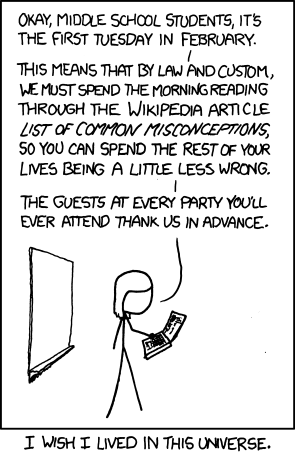
XKCD is always brilliant. Yesterday's is especially so.
The Wikipedia List of Common Misconceptions article is real, and quite well done. It is the sort of thing that everyone ought to read through at least once a year.
Wednesday, October 20, 2010
We are
Yesterday I had an idea for a new novel. Last night I couldn't go to sleep because I couldn't get that novel out of my head. The novel is about human colony ships flying out to earth-like planets that have no life and releasing various bacteria to start the terraforming process.
Today I found this fascinating article about bacteria will change your view of the world. Apparently life is dramatically more complicated than we were taught in school. How's this strike you:
Apparently bacteria research will be a high-growth field for the next few years.
Today I found this fascinating article about bacteria will change your view of the world. Apparently life is dramatically more complicated than we were taught in school. How's this strike you:
"Strictly by the numbers, the vast majority — estimated by many scientists at 90 percent — of the cells in what you think of as your body are actually bacteria, not human cells."It gets better. The article is long, but well worth your time.
Apparently bacteria research will be a high-growth field for the next few years.
Labels:
learning
Monday, October 18, 2010
Evolution is chaos!
New Scientist's recent cover article is a fascinating discussion of some new meta-analysis of several trains of study in evolution. It's not too thick with technical terms. The results are interesting and fascinating. Scientists seem to be disproving one of Darwin's big assumptions.
The really really short version is that evidence appears to indicate that climate change (and similar external events) do not cause evolution.
Plants, animals, and insects all migrate when the climate changes. And evolutionary changes do not correlate with those migrations. Evolutionary changes occur completely randomly, probably driven exclusively by internal DNA defects.
This leaves a big hole in evolutionary theory. DNA defects have shown no ability to perform the big changes, like the development of the eye or the lung.
It also makes it impossible to predict evolutionary change going forward.
The really really short version is that evidence appears to indicate that climate change (and similar external events) do not cause evolution.
Plants, animals, and insects all migrate when the climate changes. And evolutionary changes do not correlate with those migrations. Evolutionary changes occur completely randomly, probably driven exclusively by internal DNA defects.
This leaves a big hole in evolutionary theory. DNA defects have shown no ability to perform the big changes, like the development of the eye or the lung.
It also makes it impossible to predict evolutionary change going forward.
Labels:
global warming,
learning,
thinking
Saturday, October 9, 2010
"It has always been a mystery to me how men can feel themselves honoured by the humiliation of their fellow-beings."I have been thinking about this topic for quite some time. I have had trouble finding just the right words. I ran across this quote in Gandhi's autobiography, and I was amazed. He was a peculiar man, based upon the evidence of his own autobiography. And yet sometimes his words pierce so deeply to the heart of the matter.
--Gandhi
Anytime one person speaks of another their listeners learn about both parties--the speaker and the person they are speaking of.
When a speaker humiliates someone we learn that the person being spoken of may be guilty of some shortcoming. We also learn that the speaker is definitely guilty of being prideful, arrogant, petty, jealous, and many other vices.
When a speaker honors someone we learn that the person being spoken of may blessed with some praise-worthy quality. We also learn that the speaker is definitely blessed with wisdom, grace, compassion, and many other virtues.
Jesus said:
“You know that the rulers in this world lord it over their people, and officials flaunt their authority over those under them. But among you it will be different. Whoever wants to be a leader among you must be your servant, and whoever wants to be first among you must be the slave of everyone else. For even the Son of Man came not to be served but to serve others and to give his life as a ransom for many.”Leaders in our era know nothing of humility. This is an embarrassment.
--Jesus (Mark 10:42-45)
* I found this quote at the end of chapter XX of his autobiography. I looked at some prominent lists of Gandhi quotations and didn't find it anywhere.
Saturday, September 11, 2010
The human animal is complicated
Grab a few tissues and watch this video.
I found this on Fark, proving once and for all that Fark is not only a cesspool of stupidity. Carly's website is here.
Monday, May 10, 2010
The heart of marketing
If you are interested in marketing then you have to watch this video.
How does Apple generate such a dedicated following? This guy has the best answer I have seen, Market from the inside out.
Brain training
I ran across a memory game that appears to be scientifically proven to make you smarter--at least in one specific way. I've felt for a long time that chess has made me smarter. Really, any problem-solving challenge that makes you think deeply should improve your overall intelligence.
This game, Dual N-Back, promises to increase your memory and your ability to reason in new situations.
This game was developed as an extended version of a game that was developed in psychological tests that accomplished the goals of improving memory and reasoning skills. The game page includes several links to studies and articles. I would suggest starting with the Wired article.
I have not downloaded and installed it yet. I think I'm going to finish the Pray with Friends coming soon page and get that posted before I take on any new challenges.
This game, Dual N-Back, promises to increase your memory and your ability to reason in new situations.
This game was developed as an extended version of a game that was developed in psychological tests that accomplished the goals of improving memory and reasoning skills. The game page includes several links to studies and articles. I would suggest starting with the Wired article.
I have not downloaded and installed it yet. I think I'm going to finish the Pray with Friends coming soon page and get that posted before I take on any new challenges.
Wednesday, April 14, 2010
Hacking Windows 7
I'm using Windows 7. It's better than any previous version of Windows. I haven't tried it on older hardware. But on hardware that can handle it, it is slick, fast, and stable and has fewer annoying interruptions than Vista. Even on Vista I rebooted nightly in order to keep the machine running smoothly. I only reboot now after installing stuff that requires a reboot (a few applications and Windows updates.)
I had to crack open my computer case the other day, and I had a Linksys wireless card sitting on my desk gathering dust. My wireless seems to go down erratically, and I would like to be able to check it from my desktop without having to get out my laptop. So I stuck the card in.
Microsoft added the concept of "signed" drivers a few versions back. Its a good concept, in general. The people who create a driver encrypt it with a secure public key. They give Microsoft the private key. Then Microsoft can validate that the driver was developed by a safe source and hasn't been hacked. This is a reasonable security system.
It happens to also be a good revenue enhancer for hardware manufacturers. When a new version of Windows comes out the hardware manufacturers can simply fail to create new encrypted drivers for their old hardware. Now I can't take my older wireless card and reuse it in my new computer.
In all versions of Windows prior to 7, the whole signed drivers security system was optional. You got a warning, but you could install the driver and use your old hardware with the old drivers. In Windows 7 it is no longer optional. Windows 7 refuses to run unsigned drivers.
In this case, I know that the wireless card would work. I ran the Windows 7 beta, and I had this card running on it with the Vista driver. The beta of Windows 7 let me run an unsigned driver.
Monday afternoon I found this fabulous blog post on signing drivers. It turns out that I can install the Windows developer kit and sign my own drivers. It looks like a decent compromise. Hard-core propeller-heads can get old equipment to work, and they can take responsibility for the hacks. They are likely savvy enough to recognize the problems that might arise, so letting them run old hardware is fairly safe.
The Vista driver from Linksys was a .inf file instead of being a .exe (the linked .exe file is just a self-extracting zip file), like in the article. I had to figure out how to sign a .inf file. It turns out that .inf files cannot be signed. I had to convert the .inf to a .cab file, and then sign the .cab file (worked just like .exe files).
Now I have a locally-signed .cab file containing the Vista driver that I know works in Windows 7. When I install the driver it shows to be digitally signed and generates no errors whatsoever. I had to set my computer to run in 'Test Mode' to allow locally-signed drivers--I didn't want to submit my hacked driver up to Microsoft as if I were Linksys or providing the driver to the public. But after a reboot it is working.
I had to crack open my computer case the other day, and I had a Linksys wireless card sitting on my desk gathering dust. My wireless seems to go down erratically, and I would like to be able to check it from my desktop without having to get out my laptop. So I stuck the card in.
Microsoft added the concept of "signed" drivers a few versions back. Its a good concept, in general. The people who create a driver encrypt it with a secure public key. They give Microsoft the private key. Then Microsoft can validate that the driver was developed by a safe source and hasn't been hacked. This is a reasonable security system.
It happens to also be a good revenue enhancer for hardware manufacturers. When a new version of Windows comes out the hardware manufacturers can simply fail to create new encrypted drivers for their old hardware. Now I can't take my older wireless card and reuse it in my new computer.
In all versions of Windows prior to 7, the whole signed drivers security system was optional. You got a warning, but you could install the driver and use your old hardware with the old drivers. In Windows 7 it is no longer optional. Windows 7 refuses to run unsigned drivers.
In this case, I know that the wireless card would work. I ran the Windows 7 beta, and I had this card running on it with the Vista driver. The beta of Windows 7 let me run an unsigned driver.
Monday afternoon I found this fabulous blog post on signing drivers. It turns out that I can install the Windows developer kit and sign my own drivers. It looks like a decent compromise. Hard-core propeller-heads can get old equipment to work, and they can take responsibility for the hacks. They are likely savvy enough to recognize the problems that might arise, so letting them run old hardware is fairly safe.
The Vista driver from Linksys was a .inf file instead of being a .exe (the linked .exe file is just a self-extracting zip file), like in the article. I had to figure out how to sign a .inf file. It turns out that .inf files cannot be signed. I had to convert the .inf to a .cab file, and then sign the .cab file (worked just like .exe files).
Now I have a locally-signed .cab file containing the Vista driver that I know works in Windows 7. When I install the driver it shows to be digitally signed and generates no errors whatsoever. I had to set my computer to run in 'Test Mode' to allow locally-signed drivers--I didn't want to submit my hacked driver up to Microsoft as if I were Linksys or providing the driver to the public. But after a reboot it is working.
Monday, April 12, 2010
What is it for, then?
Food isn’t about Nutrition
Clothes aren’t about Comfort
Bedrooms aren’t about Sleep
Marriage isn’t about Romance
Talk isn’t about Info
Laughter isn’t about Jokes
Charity isn’t about Helping
Church isn’t about God
Art isn’t about Insight
Medicine isn’t about Health
Consulting isn’t about Advice
School isn’t about Learning
Research isn’t about Progress
Politics isn’t about Policy
Marginal Revolution points to an intriguing post at Overcoming Bias, which in turn points to an earlier O.B. post, which in turn points to yet another earlier similar interesting post.
The source articles on O.B. are pretty thick. Robin Hanson is an academic's academic. Nice guy, but he doesn't write for normal folks to read. I'll recap for you:
* Scientists can't figure out why human brains are so large. One (apparently new) theory is that humans are unconsciously deceptive--we tell ourselves and each other a near constant stream of lies, and we have to have these too big brains in order to encode and decode all of the lies.
* We can think of this dishonesty as sending signals to fool our competitors, like bluffing (a simple example; there are hundreds of other examples.)
* Society is then made up of people who are all being dishonest all the time in little ways. The net result is that no individual gets what they want. But as a whole society generally performs fairly well; because the average of all of those little lies is very close to the average of all of the little truths behind the lies.
* If we examine human institutions from the assumption that everyone is signaling and hiding their real desires and/or intentions, then previously confusing situations become clear (or, at least, clearer.)
* The system is vulnerable to truth-tellers. In large and small situations, truth-tellers can unmask the deceptions and get what they want, over the short-term. Over the long-term people will return to their comfortable little lies; because their large brains are hard-wired for it.
* Truth-tellers have to be careful. These messengers tend to get shot.
I love the 'X isn't about Y' poem (rhyming concepts instead of sounds.) This is how Robin explains it: "When I say “X is not about Y,” I mean that while Y is the function commonly said to drive most X behavior, in fact some other function Z drives X behavior more."
Identifying and naming the various Z's can be fun and enlightening. Probably different people have different Z's. For instance, for one person clothes might really be a signal of their status and/or group membership (business people in suits, or gang members, for instance) and for others clothing might be about hiding their true identity. Maybe not, though. That was the best example I could think of, and its a pretty slim distinction.
Then maybe this is a Rorschach test. How would you fill in these blanks?
Clothes are really about ___________________.
Bedrooms are really about ___________________.
Marriage is really about ___________________.
Talk is really about ___________________.
Laughter is really about ___________________.
Charity is really about ___________________.
Church is really about ___________________.
Art is really about ___________________.
Medicine is really about ___________________.
Consulting is really about ___________________.
School is really about ___________________.
Research is really about ___________________.
Politics is really about ___________________.
That third linked article from O.B. is about what Robin thinks Politics is really about. Robin thinks that politics are about getting respect. If that is true then a Manchurian Candidate could focus on a message of respect and win in a landslide. So this is not necessarily just an academic exercise. If we know what someone really wants then we can find new and innovative ways to meet that need.
My own answers are pretty cynical. That probably has something to do with my mood today. I might revisit this post when I'm feeling happier.
Clothes are really about group membership.
Bedrooms are really about feelings of insecurity.
Marriage is really about loneliness.
Talk is really about emotional connection.
Laughter is really about embarrassment and confusion.
Charity is really about affirming myself.
Church is really about seeking affirmation.
Art is really about communicating unpopular opinions.
Medicine is really about fear.
Consulting is really about covering myself.
School is really about conformity.
Research is really about competition.
Politics is really about stealing money from the public.
Some of these I have thought and felt for a long time.
I have a note taped to my desk that says "The goal of communication is emotional connection. Fact transmission is only a useful by-product." I've had it for years. I can't remember where I got the idea, but I have understood for years that I am too focused on facts and too ignorant of emotional connection. It's a weakness that I am working on. Obviously there is much left to do.
I read Steve Martin's biography, Born Standing Up. Steve goes into great detail about his early experiments in comedy. He began experimenting with telling jokes that lacked punchlines. He would just riff from discomfort to confusion and garner laughter from the audience's inability to decide what else to do. (Of course he explains it much better than that.)
Democracy 2.0 is a flaming critique of the political establishment. My feelings about politics are well documented.
But I have been struggling with how to communicate Democracy 2.0 for years, too. I've thought a lot about art as a medium for communicating Democracy 2.0, or as least my critiques of the current system. I've been thinking about writing fiction as a way to communicate my critiques.
I used to manage a team of consultants. It's not a secret within the consulting community that people hire consultants as a form of job insurance in case the project fails. The consultants always take the blame. Any consultant who attempts to subvert this unwritten rule will find himself/herself off contract and blackballed.
The critique of charity is an old saw. This was Freud's explanation for charity, if I remember correctly.
My opinion of church will be quite controversial among my friends, and so I feel like a word of explanation is necessary. There are two types of people in church: believers and non-believers. Fellowship among believers is essentially a form of affirmative encouragement. Non-believers seem to be looking for someone to tell them that they are ok. The word 'encouragement' covers the believers, but not the non-believers. 'Affirmation' covers both groups better. If you have a better word then I'm all ears.
Clothes aren’t about Comfort
Bedrooms aren’t about Sleep
Marriage isn’t about Romance
Talk isn’t about Info
Laughter isn’t about Jokes
Charity isn’t about Helping
Church isn’t about God
Art isn’t about Insight
Medicine isn’t about Health
Consulting isn’t about Advice
School isn’t about Learning
Research isn’t about Progress
Politics isn’t about Policy
Marginal Revolution points to an intriguing post at Overcoming Bias, which in turn points to an earlier O.B. post, which in turn points to yet another earlier similar interesting post.
The source articles on O.B. are pretty thick. Robin Hanson is an academic's academic. Nice guy, but he doesn't write for normal folks to read. I'll recap for you:
* Scientists can't figure out why human brains are so large. One (apparently new) theory is that humans are unconsciously deceptive--we tell ourselves and each other a near constant stream of lies, and we have to have these too big brains in order to encode and decode all of the lies.
* We can think of this dishonesty as sending signals to fool our competitors, like bluffing (a simple example; there are hundreds of other examples.)
* Society is then made up of people who are all being dishonest all the time in little ways. The net result is that no individual gets what they want. But as a whole society generally performs fairly well; because the average of all of those little lies is very close to the average of all of the little truths behind the lies.
* If we examine human institutions from the assumption that everyone is signaling and hiding their real desires and/or intentions, then previously confusing situations become clear (or, at least, clearer.)
* The system is vulnerable to truth-tellers. In large and small situations, truth-tellers can unmask the deceptions and get what they want, over the short-term. Over the long-term people will return to their comfortable little lies; because their large brains are hard-wired for it.
* Truth-tellers have to be careful. These messengers tend to get shot.
I love the 'X isn't about Y' poem (rhyming concepts instead of sounds.) This is how Robin explains it: "When I say “X is not about Y,” I mean that while Y is the function commonly said to drive most X behavior, in fact some other function Z drives X behavior more."
Identifying and naming the various Z's can be fun and enlightening. Probably different people have different Z's. For instance, for one person clothes might really be a signal of their status and/or group membership (business people in suits, or gang members, for instance) and for others clothing might be about hiding their true identity. Maybe not, though. That was the best example I could think of, and its a pretty slim distinction.
Then maybe this is a Rorschach test. How would you fill in these blanks?
Clothes are really about ___________________.
Bedrooms are really about ___________________.
Marriage is really about ___________________.
Talk is really about ___________________.
Laughter is really about ___________________.
Charity is really about ___________________.
Church is really about ___________________.
Art is really about ___________________.
Medicine is really about ___________________.
Consulting is really about ___________________.
School is really about ___________________.
Research is really about ___________________.
Politics is really about ___________________.
That third linked article from O.B. is about what Robin thinks Politics is really about. Robin thinks that politics are about getting respect. If that is true then a Manchurian Candidate could focus on a message of respect and win in a landslide. So this is not necessarily just an academic exercise. If we know what someone really wants then we can find new and innovative ways to meet that need.
My own answers are pretty cynical. That probably has something to do with my mood today. I might revisit this post when I'm feeling happier.
Clothes are really about group membership.
Bedrooms are really about feelings of insecurity.
Marriage is really about loneliness.
Talk is really about emotional connection.
Laughter is really about embarrassment and confusion.
Charity is really about affirming myself.
Church is really about seeking affirmation.
Art is really about communicating unpopular opinions.
Medicine is really about fear.
Consulting is really about covering myself.
School is really about conformity.
Research is really about competition.
Politics is really about stealing money from the public.
Some of these I have thought and felt for a long time.
I have a note taped to my desk that says "The goal of communication is emotional connection. Fact transmission is only a useful by-product." I've had it for years. I can't remember where I got the idea, but I have understood for years that I am too focused on facts and too ignorant of emotional connection. It's a weakness that I am working on. Obviously there is much left to do.
I read Steve Martin's biography, Born Standing Up. Steve goes into great detail about his early experiments in comedy. He began experimenting with telling jokes that lacked punchlines. He would just riff from discomfort to confusion and garner laughter from the audience's inability to decide what else to do. (Of course he explains it much better than that.)
Democracy 2.0 is a flaming critique of the political establishment. My feelings about politics are well documented.
But I have been struggling with how to communicate Democracy 2.0 for years, too. I've thought a lot about art as a medium for communicating Democracy 2.0, or as least my critiques of the current system. I've been thinking about writing fiction as a way to communicate my critiques.
I used to manage a team of consultants. It's not a secret within the consulting community that people hire consultants as a form of job insurance in case the project fails. The consultants always take the blame. Any consultant who attempts to subvert this unwritten rule will find himself/herself off contract and blackballed.
The critique of charity is an old saw. This was Freud's explanation for charity, if I remember correctly.
My opinion of church will be quite controversial among my friends, and so I feel like a word of explanation is necessary. There are two types of people in church: believers and non-believers. Fellowship among believers is essentially a form of affirmative encouragement. Non-believers seem to be looking for someone to tell them that they are ok. The word 'encouragement' covers the believers, but not the non-believers. 'Affirmation' covers both groups better. If you have a better word then I'm all ears.
Saturday, March 27, 2010
Productcamp Austin
I attended Productcamp Austin today. It was a great event. I learned a lot. Most of it was pretty high-level. But I needed that. I attended discussions outside of my core experience (mostly marketing and product strategy), so high-level was right for me.
It was free for attendees. So a big thank you goes out to the corporate sponsors:
The AT&T Conference Center
Planview
The 280 Group
Pragmatic Marketing
Lucrum Marketing (headed by a fellow Journyx alum, Tom Evans)
Austin Ventures
MailChimp
Build-a-Sign
Zenoss
ZigZag Marketing
CommonSense
I was especially impressed by a few of the speakers.
Josh Duncan was really fun and engaging. He is a very good public speaker. Lots of pictures, jokes, and give-aways. He had three points, and he gave us a postcard with the three points in napkin-drawing form. Smart guy. I've added his blog to my regular read list.
Sharon Drew Morgen was new to the product marketing circuit. She has been focused on sales training, and she seems to be in the process of adapting her material to suit this market. Her ideas and insights are quite powerful. I will be digesting her material for some time to come. I've added two of her books to my Amazon wishlist.
Jim Foxworthy (President) and many of the Pragmatic Marketing team were there. Every one I spoke to or heard speak was very knowledgeable. If you are thinking about a social marketing product management strategy, you should check out this company. I was able to talk to Jim some, and he certainly seems like someone I would enjoy working with.
Planview bought lunch (yeah!) and held a raffle for an iPad. I suspect someone who is currently employed will win the iPad, but it was neat to see someone taking this group seriously.
There is an other Productcamp coming in August. I plan on being there. I will probably volunteer to help out. You should come, too, if product management, development, design, or marketing are on your job radar at all. You can't beat the price. I've never gotten this level of quality at that price before.
It was free for attendees. So a big thank you goes out to the corporate sponsors:
The AT&T Conference Center
Planview
The 280 Group
Pragmatic Marketing
Lucrum Marketing (headed by a fellow Journyx alum, Tom Evans)
Austin Ventures
MailChimp
Build-a-Sign
Zenoss
ZigZag Marketing
CommonSense
I was especially impressed by a few of the speakers.
Josh Duncan was really fun and engaging. He is a very good public speaker. Lots of pictures, jokes, and give-aways. He had three points, and he gave us a postcard with the three points in napkin-drawing form. Smart guy. I've added his blog to my regular read list.
Sharon Drew Morgen was new to the product marketing circuit. She has been focused on sales training, and she seems to be in the process of adapting her material to suit this market. Her ideas and insights are quite powerful. I will be digesting her material for some time to come. I've added two of her books to my Amazon wishlist.
Jim Foxworthy (President) and many of the Pragmatic Marketing team were there. Every one I spoke to or heard speak was very knowledgeable. If you are thinking about a social marketing product management strategy, you should check out this company. I was able to talk to Jim some, and he certainly seems like someone I would enjoy working with.
Planview bought lunch (yeah!) and held a raffle for an iPad. I suspect someone who is currently employed will win the iPad, but it was neat to see someone taking this group seriously.
There is an other Productcamp coming in August. I plan on being there. I will probably volunteer to help out. You should come, too, if product management, development, design, or marketing are on your job radar at all. You can't beat the price. I've never gotten this level of quality at that price before.
Labels:
learning
Subscribe to:
Posts (Atom)